1001 water-wise ways: Not a round-up, but a bit of a rant
Water everywhere. And wrecks.

Water everywhere. And wrecks.

I haven't written any water blogs this week, for two reasons. The first has been the final flurry to get my book on water (of which MUCH more news VERY SOON) off to the printers. Always a period of great excitement and manic stress. Second, I've been sitting with my hands over my mouth like the third monkey, trying very hard not to gibber with rage and dismay at Mmusi Mainane's pronouncement that we probably won't experience Day Zero this winter, and the subsequent reporting, which has ranged from sensible to spectacularly irresponsible ("Day Zero cancelled! It was all a hoax/plot/manipulation by the DA/ANC/Israelis/bottled water manufacturers/lizard people/[insert villain here] to sow panic/manipulate the electorate/install desalination plants/make loads of money/insert anal probes[insert conspiracy here]." This weekend's newspapers show more than one sensible and experienced journalist falling into these traps.

The purpose of this blog is to provide a platform for practical tips on living with less water, and after my initial roasting of the mayor for her stubborn refusal to acknowledge the enormity of the water crisis, and my general yelling at everyone I hold responsible, I've steered clear of of the toxic stew of politics. As I've said before, blame for the mishandling of the crisis (certainly from a PR point of view) is a terrible waste of energy. However, the worse-than-useless water-crisis PR we've been seeing sometimes entwines with irresponsible media reporting, social media pours on the gasoline, and the next thing, there's a misinformation wildfire galloping across our screens.

I looked carefully at what Maimane said, and in fact, it was unremarkable: no different from what every single sensible person and water pundit has been saying for the last month: IF we go on saving every drop of water left in our dams, and IF we get decent rains (let me remind everyone we have no control whatsoever over this huge great big IF): then (and only then), we might not have to face Day Zero this winter.

OK, then. Five minutes later, social media was awash with tales of the cancellation of Day Zero, cries of what ninnies we'd been to buy tanks and bottled water, how we'd been getting into a lather over nothing, loud cheers because we could all go back to hot baths and watering our lawns, how we'd been lied to from the beginning. (Here's a fair account of the blowback.)

How did we get here from Maimane's temperate and accurate statement? There was only one small problem: the fact that he said anything AT ALL.

Frankly, I do not want to hear one more word, from one single politician with an eye on the forthcoming elections, about the water crisis. Just shut up. All of you, successive administration after administration, let us down; you knew this was coming and you did pathetically little to avert it other than shutting your eyes, crossing your fingers and chanting rhetoric. IMO, you have forfeited the right to speak. You have absolutely no business pontificating about what might or might not happen, and if you don't live in this city, don't congratulate us on how we're doing -- go check on the status of your local reservoirs and the water-wasting habits of your own constituents. You'll be facing your own Day Zero soon enough.

And (this is for ALL politicians): stop using a national disaster to score points. It's not just opportunistic, it makes you look stupid. I'm not going to explain why claims that this is All A Plot are ridiculous. (Apart from anything else, HOW? Did the DA or whoever fiendishly conspire with aliens to suck the contents of the Cape dams up into vast spaceships, which are now loitering round the dark side of the moon until Nefarious Purposes Have Been Achieved? And then they'll kindly return our water and we can all leap into jacuzzis again?) John Maytham debunks this kind of thinking very well here, but this showcases the irresponsibility of the language about Day Zero.

This leads to the thorny topic of media irresponsibility: News24 provided a sober report: we MAY avoid Day Zero, IF and IF. But within minutes, subs across the country were racing to splash headlines about NO MORE DAY ZERO ("Water panic over for now"; "How Cape Town avoided Day Zero" [???], etc) all over the show. Plummeting national standards of reporting and subbing as the media is eaten from the inside out are a subject for another day, but I take exception to the irresponsibility of reporting inaccurately on a topic this sensitive and critical; also one where people veer from panic to complacency with few stops in between. We're all fed up with the smell of grey water, so don't give us the false impression that it's safe to go back to casting drinking water down our toilets.

Both the City's PR campaigners and the media have used the language of exceptionalism -- phrases like a "hundred-year drought" and "unprecedented" have been tossed about -- and there is this touching faith that the rains will come along and save us all, and everything will go back to normal.

People: WE BROKE THE WEATHER. It is going to take decades, if ever, to fix it. Climate change is real and it is here. Will it rain this winter? We. Don't. Know. Half an hour on Google confirms this: nobody knows, none of the meteorologists and weather forecasters and scientists. (This link, from the SA Weather Service and the Dept of Environmental Affairs, should get an award for sheer uselessness.) What we DO know is that rain needs to fall not just in huge quantities, but in the catchment areas for the dams, and it needs to be the right sort of rain: soft, soaking, continuous, so that it replenishes rivers and groundwater instead of dashing off the miles of concrete and tar and paving and decking we've slapped all over the sponge that is the earth, down stormwater drains, and out to sea.

Regardless of what the politricksters and the City's PR mavens may say (I don't think I'd believe a word out of their mouths by now, not even "hello"), the situation is Serious. Sure, we may dodge Day Zero this winter. But where are we going to be next January? Or the summer after that? And the next one? And more South African cities are going to face water scarcity, and soon (Jozi, having been saved by the calvary aka the Lesotho Highlands Water Scheme a little while back, is slurping through their extra water at a frightening rate).

But let's stress once again: there is no need to panic. If nothing else, we've learned first exactly how much water we need each day; and once over the shock of that, we've realised how little that amount actually is. Waterwise living is going to be part of our shared future; already experienced by millions reliant on standpipes, wells and rivers, it's going to be taught in schools, practiced by businesses, legislated properly (OK politicians, now THERE'S something useful you can do -- apparently Cape Town's water bylaws are indeed being as rapidly amended as is consistent with due process). What we won't be able to go back to is our previous helpless reliance on local government and our luxurious use of water. And a little independence and the ability to be water-thrifty are great things to carry into our future.
Helen Moffett
1001 water-wise ways: This one is for small businesses
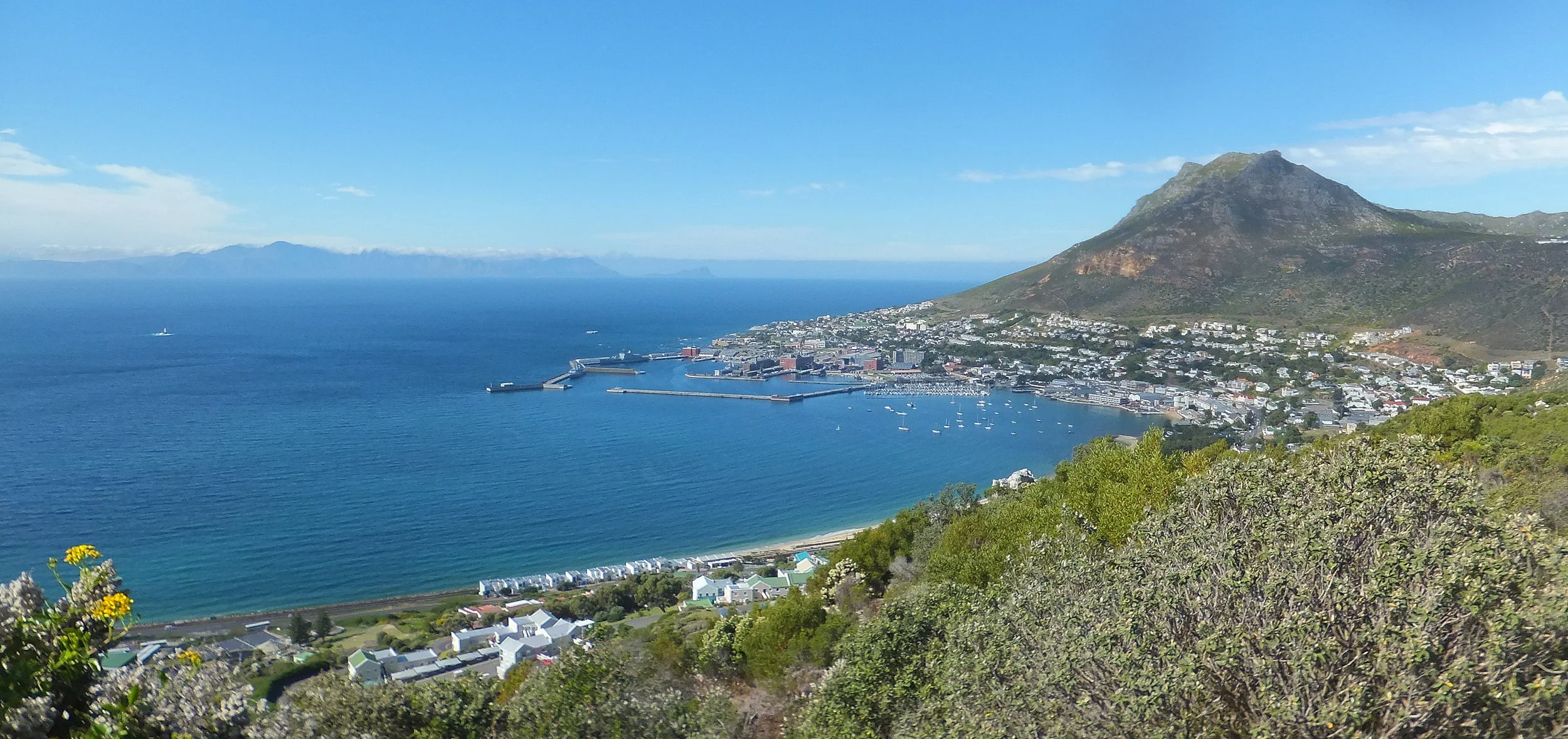
Simonstown: water, water everywhere, but...

Simonstown: water, water everywhere, but...

I can't believe this is the sixth water round-up -- I had such good intentions of keeping all the tips numbered, but that went out the window (or out with the bathwater?) a while back. And still the tips and ideas and mind-shifts keep coming -- thanks to everyone who's gotten in touch, it really is appreciated.

It was a busy water week, and I was asked to speak to the Simonstown Business Association members -- a sparky bunch, and they're responsible for much of what follows. I felt a charlatan speaking to folk in the hospitality and retail industries, as I've never run a small business, unless you count being a freelancer for 21 years. But we're all sharing the same water learning curve, so it was good to bounce ideas off this group.

Businesses are perhaps more focused than the rest of us if we think about the progress of our responses to the crisis. We've clearly gotten over the panic and distress of late January and early February. Now we're either at the denial stage (we seem to believe that Day Zero will never come) or we've knuckled down and are doing our best, and after the initial wailing, we've found it's not hard to manage on less than 50 litres a day each, and soon the rains will come, and what was all that fuss about?

But small business owners -- especially those in the hospitality industry -- know that it will never quite be "business as usual" again. The threat of water scarcity is real, it is here, and it is not going away. We will encounter this scenario again and again in the near future, and any preparation we do now will stand us in good stead.

We all agree on one thing: we want visitors and tourists to keep coming to Cape Town. As said before, many times, it's critical that people keep their jobs, especially in the restaurant and guesthouse industries -- the crisis has already cost so many jobs. And to keep employing people, we need to keep our businesses afloat (indulge me), and that means keeping people flowing in (OK, I'll stop now).

This may be too Pollyanna for many, but maybe we can make water-saving fun, inventive and even a bit sexy, so that tourists can reminisce and even brag a little: "Remember when we went to Cape Town during the water shortage, and we all had buckets in the showers?" Our attitude in communicating with guests, clients and customers is also critical: if we are dour and finger-waggy about the Rules (like those British seaside B&Bs of the 1950s and 60s), we're going to alienate people. Try to serve up water restrictions with a dollop of humour: one of my favourite guesthouse tricks, practiced by my friend Penny, is to criss-cross the bath with crime-scene tape. This is very funny, a great Instagram opportunity, and no one feels preached at.

This is also an opportunity to rethink the way we train our staff: many of them have first-hand experience of water-saving ways, but may be weary at the thought of having to do things the long and difficult way round. I've written before that according to psychologists and social workers I've chatted to, rewards, praise and making certain behaviours "cool" are the best routes to take when changing habits and routines, so be a cheerleader for your staff: give rewards or small prizes for the most water-wise behaviours and strategies. Keep encouraging and praising, and if your guests or clients join in, thank them and make them feel that they're on your team -- part of the solution, not the problem.

DSC_0892.JPG


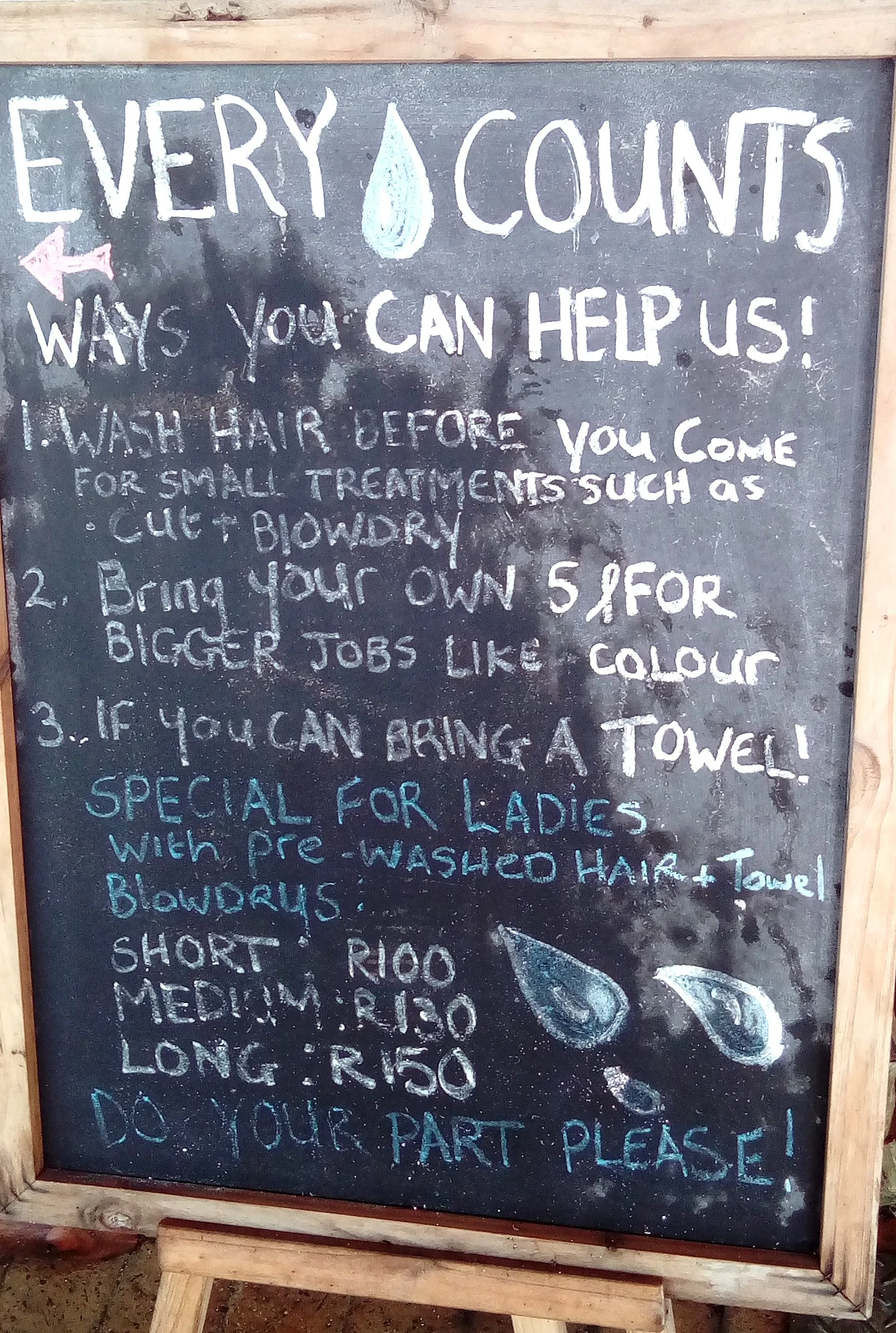
Out this morning, I spotted this sign chalked up outside a local hairdressing salon, and liked the cheerful and can-do tone, and also the fact that it offers water-wise clients special prices. Everyone likes a bargain, and the current scenario does present opportunities as well as difficulties.

I've already suggested that guesthouses offer visitors who bring and take away their own linen (especially if they are business visitors only staying for one or two nights) a free bottle of wine or small discount or similar, and we've already seen Anita's excellent water-wise tips for restaurants and coffee-shops. Just as some guesthouses have those decanters of sherry standing in the hallway to welcome guests, perhaps early in the evening is a good time to set out a pretty old-fashioned ewer and jug full of warm scented water from a well or spring, with embroidered handtowels, to welcome guests back from a hot day eating sticky ice-creams at the beach, or clients to a restaurant. Water-wise does not have to equate grim. It can still be gracious.

To go back to planning for the future, some long-term ideas: almost every guesthouse or hotel bathroom in Southern Europe (which has the same Mediterranean climate as us) has only a shower, toilet, bidet and basin. This really does cover all bases (couldn't resist), and these are the bathrooms our hospitality industry needs as premises are expanded and converted, rather than spa baths and vast Victorian tubs. This is not Pudding Island and we do not live under a perpetual cloud of drizzle.

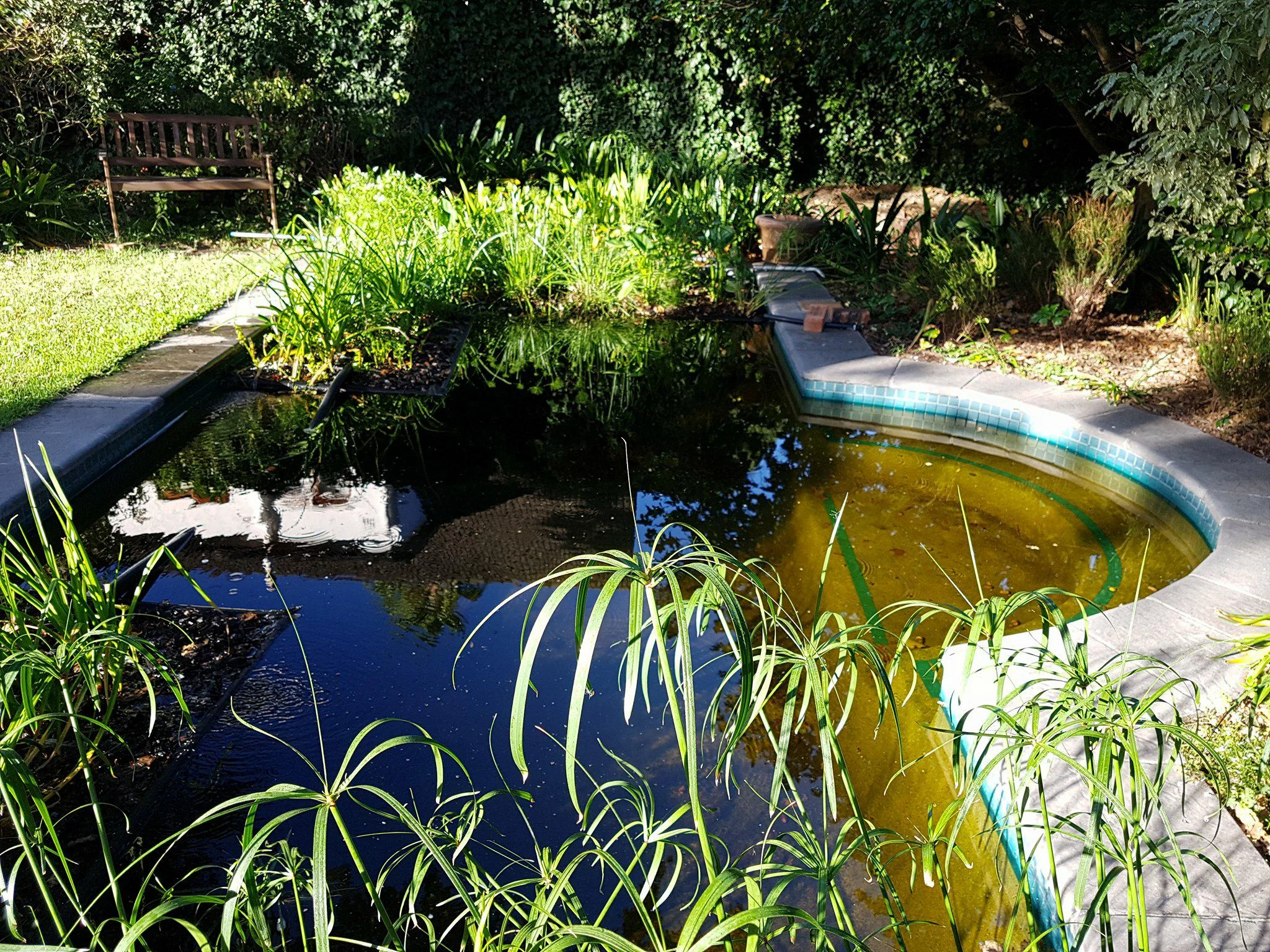
Something to consider -- you could even make it a selling point -- is converting your pool into a soothing and attractive eco-pool. I've been smitten by a friend's successful conversion: look at this beauty, once a regular chlorinated pool (I am not a fan of that unnatural blue).

Picture credit: Helen Laurenson

Picture credit: Helen Laurenson

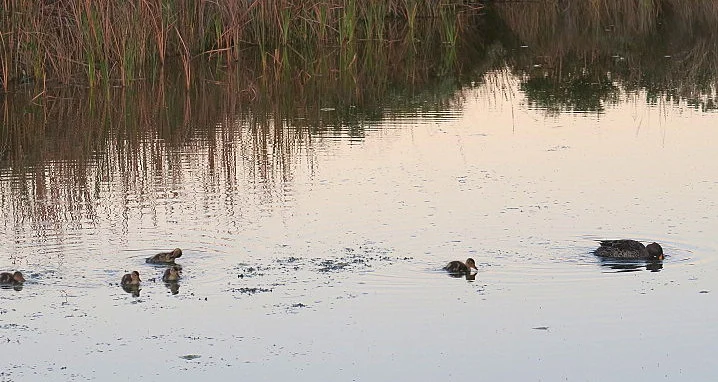
The idea is to keep a space amidst the reeds and rushes for taking dips, and the water is clean, soft on the skin (the source in this case is the overflow from the rain-tank, and the above shows its natural colour) and there's no need to shower afterwards to wash off that chlorine itch. Consult an expert if necessary and do the conversion over the winter, so that you have a beautiful green pool for your guests to lie beside next summer, where they can enjoy the dragonflies and frogs (who will keep the mozzies at bay).

Helen Moffett
1001 water-wise ways: Tips for older folk
IMG_7700.JPG

This week, I was asked to speak briefly to the residents in the retirement village in which I find myself renting (it's a long story), and it was humbling to be reminded that even within the middle classes, one-size-does-not-fit-all in water-tip terms. Some of the water-wise ways I advocate take a degree of physical strength and flexibility we can't take for granted, especially not in older bodies. A physiotherapist I saw commented not just on "bucket back" (here's a brilliant blog by a water warrior laid low by this very phenomenon), but the rash of shoulder and arm injuries she is seeing in the elderly who are hoisting water containers around.

It's not much of a win if your water-saving habits cause you physical pain and injury. I blithely advocate that those unused to heaving buckets talk to a yoga teacher or athlete or physio about how to protect their bodies from injury when lifting anything heavy. However, years of Pilates have taught me that it's not enough just to suck in the tummy and bend the knees when lifting (although this certainly helps); regular work on core physical strength is necessary for maximum protection. (There's an opportunity for a win-win here: strengthen your body and your water-resilience at the same time. There are exercise routines that can be practiced and adapted for any age.)

So the most helpful tip: don't lift anything heavy. If you're not in the first flush of youth, or have a pre-existing injury or condition, physios recommend not lifting anything heavier than a 5-litre container of water. Forget those 25-litre containers. If you're collecting from a spring (and I see a lot of older folk doing this), take along a husky grandkid to do the heavy lifting.

In your home, if you have to move water around, make lots of little journeys. And instead of lugging one full bucket, rather pick up two half-full buckets, so that your body is balanced. Also finagle your water routines so that you're not hefting brimming buckets the whole time. For instance, instead of pouring buckets of grey water down the toilet, fill up your cistern a jugful at a time. (This also makes for a more effective flush.) I've discovered that watering-cans are great for filling toilet cisterns, and there's much less chance of splashing grey water around. (For maximum protection when handling grey water, wear rubber gloves.)

I'd nix my cooler-box "washing machine", too: if you have a washing-machine, rather use the soak and rinse-cycle system: pre-treat stains, soak laundry in a little warm water and low-foam detergent and then put into your machine and turn the dial to the rinse cycle. And it bears repeating, wipe and scrape plates (don't rinse) before putting them in the dishwasher, and run it only when it's packed to the gills.

When it comes to the shower, older people should NOT be stumbling around surrounded by buckets, and should be especially cautious about wet and slippery surfaces. Rather use a wide, shallow flat-bottomed container to catch shower water, and cover the bottom with non-slip mats. Or sit on a plastic chair in the shower and use the pressure-sprayer method described here for a nice, leisurely warm wash that uses remarkably little water.

What you can change, however, is your entertaining and eating habits. Keep up the cups of tea: the elderly are more at risk of dehydration. Continue to have people round, but try potlucks, eat out of containers with your fingers, and toss away your inhibitions about paper plates, napkins and compostable cups. My parents, in their eighties, have taken to religiously re-using crockery and utensils: glasses and plates used for toast, biscuits, etc, are the main target, and they've got the dishwasher down to a weekly run.

It also occurred to me that because I have so much harvested water in my home, I can be quite extravagant with it. If you live in a retirement village, however, especially one of those that did not see Watergeddon coming or prepare for it, you are likely to be dependent on municipal water, which can cause great anxiety. Try to get a little "off-grid" water in, even if this is just 5 litres from a spring, or basins under your downpipes. If you have a neighbour or family member who regularly harvests water, give them a few 5-litre containers and ask if they would mind collecting for you as well. It's a most satisfying experience washing up or creating a hand-wash station or doing the laundry with "off-grid" water. I boil harvested water for heating (you can use the kettle for any water that is visibly clean), or you can order a small electric bucket or tea urn online and stand it next to your sink for washing up. Note that if you get sufficiently independent, you can switch off your geyser for the duration, which will have a dramatically lowering effect on your electricity consumption, even if (to my surprise) you have a solar geyser.

Finally -- and this is for everyone to watch and enjoy -- the delightful Suzelle has created this water-saving video full of wonderful "water recipes" (for hand sanitiser, wet wipes, hand wash and more) that makes this whole adventure seem like fun.

IMG_7711.JPG
Helen Moffett
1001 water-wise ways: a cautionary tale of two cauliflowers
The white one came from the supermarket. The purple one I grew.

The white one came from the supermarket. The purple one I grew.

In late October 2016, I planted a tiny cauliflower seedling. The drought was biting, but not yet as badly as this summer. At first, I just kept the seedling wet. It soon grew into a magnificent flourish of leaves. And was that the hint of a cauli I saw? So I kept watering it. And it thirstily gulped down at least a litre every other day. For nearly three months! Even though some of it was black water (from the washing-up), there was no getting away from it: to grow ONE cauli (admittedly delish and beautiful – stir-fried with basil pesto in the end) took close on 45 litres of water.

Which brings me to the tip of the week: visit just a few of the websites that tell you how much water it takes to produce food. The figures are sledge-hammering: 1 239 litres to produce one pizza? I couldn't actually get my head around the numbers. But no, the sources explain clearly and in scientific terms how much water goes into growing food, cleaning, preparing and processing it, and it is a hell-no-you-must-be-joking amount. So one thing is crystal-clear: in an era where it's horrendously unfashionable, if not draconian, to tell folk to finish what's on their plates, one of the least water-wise things you can do is waste food.

This is something to discuss with your family, especially teens. It's a good idea to ask everyone to dish up less than they might actually want, and to go back for seconds if they still have a gap to fill. And not wasting food goes double and triple for restaurants. I've lost count of the times I've seen I've seen kids order a milkshake, burger and chips, inhale the milkshake (which arrives first), then eat a few chips and send the burger back almost untouched. Apart from the ethics of dissing the minimum-wage earner in the kitchen who has to clear up, the water tab is gargantuan. How to get around this, especially given the often over-large portions doled out in restaurants? Doggie-bags. Better still, take your own Tupperware containers when eating out and bring everything you don't consume home. Yes, I know what it looks like, but consider this: do this just ONCE and your mortified teenager will never again push away a burger after just one bite.

If you can bear to go back and look at those figures again, something else will hit you between the eyes: the vast difference in water consumption between producing meat and vegetables, with grains coming somewhere in the middle. This alone is an argument for eating far less meat (or going vegetarian or vegan) and making veg a bigger part of our daily diets. Also, production and processing add megalitres more to the water footprint of all packaged and pre-prepared foods. Sometimes this is no bad thing: I now buy cauliflowers from stores, simply because the economies of scale involved in growing veg in large amounts usually means that less water is used.

Nevertheless, we all have to eat; and ever since humans first started making fires, food has been tied up with social cohesion, family rituals, pleasure and celebration. No one hates food guilt more than me. So what's to do? I think it was writer and green food activist Michael Pollan who said: "Eat real food. Not too much of it. Mainly vegetables." As someone who drools over artichokes, aubergines and asparagus (and we haven't even moved onto the second letter of the alphabet yet), this isn't as extreme as it might sound.

These are of course long-term strategies, but now that Day Zero has been pushed back again, and we are all crossing our fingers and thinking that maybe we might dodge a bullet, it's the long-term stuff that will save our hides in the end. Certainly our childrens's hides.

Thinking long-term about tackling the real Tyrannosaurus Rex in the room – climate change – needn't result in hapless despair. Interestingly enough, the only cure for global warming is to generate more water by planting more green stuff, especially indigenous trees. These release moisture into the air, hold it in the soil, and have a moderating effect on temperature. If you want to leave a truly valuable legacy, plant a small forest. We need to stop creating English cottage-style and other thirsty exotic gardens in the arid Cape, dig up our lawns and replace them with beautiful, hardy, indigenous groundcovers and plants.

Indigenous gardening will make you fall in love with spring all over again.

Indigenous gardening will make you fall in love with spring all over again.

Allied to this, if you want to protect Mother Nature, improve your soil. Feed it and don’t cover it. Earth is a valuable sponge that helps hold our water supplies and is a source for evaporation back up into the air. Concrete, tarmac, paving stones and decks render the soil sterile and dead, and send rain run-off into drains and the sea, where it's wasted – that's if it doesn't first cause flooding.

Now back to cauliflower: when putting in a new veg garden last July, I planted one cauli seedling. "You're on your own," I told it. "No extra water for you." Well, with the scant winter rains and kitchen water poured through a home-made filter, this:

IMG_7412.JPG

became this:

IMG_7881.JPG

... which, in the fullness of time, became this:

IMG_7646.JPG

Lesson humbly learned: plant thirsty veg in the winter, not spring.

PS: Very NB tip, especially with the disquieting news that the City intend calculating water usage when preparing accounts for the next while; you can get around nasty overbilling shocks by registering for e-services, reading your own meter (which we should all be doing anyway) and supplying the results to the City online, or by calling 0860103089, or emailing water.meterreading@capetown.gov.za. Some users are reporting a few hitches, but one of these routes should get your accurate reading to the City. Good luck!


Helen Moffett
1001 water-wise ways: rewiring our heads
DSCF0825.JPG

Who else is finding that having to think about how we live with water is reframing the way they think about MANY other things? As we tackle some of the issues attached to the water crisis, I find I'm questioning certain ideas, or finding that certain views that have always been swimming around at the bottom of my mental fishtank are rising to the surface.

The other fascinating thing is talking to psychologists, social workers and activists about the big emotional swings we're seeing. There's something about fear of loss of water that presses all sorts of buttons. In the last month Cape Town has swung from panic to denial (with no doubt all the other stages of loss still to traverse), but with lots of "can-do" spirit as well. People who've had the money to install alternative water systems (adapting their gutters, putting in tanks and pumps, using their pools to harvest overflow) have been telling me how more confident and in control they feel as a result. Part of the price we pay for a so-called "civilised lifestyle" involves handing power over to the authorities and trusting them to take care of us. Taking that power back, when we can, can be incredibly liberating. The day I realised I could go off the water grid if I had to, simply by dint of hauling water from springs and wells (like millions across the globe) felt like strings loosening.

And so I've realised that being water-wise is more than accumulating tips and putting them into practice, even though these are super-helpful (and thanks to all those who keep sending them in -- my favourite this week, from my editor, was "Stick your sweaty gym clothes in the freezer instead of washing -- kills all the odour-causing bugs").

I've been setting my sights on those communal villages -- retirement complexes, gated estates, life-right villages, etc -- who, having failed to prepare their buildings or grounds for a water-scarce future, are now throwing bureaucratic obstacles in the way of those frantically trying to make their homes less dependent on municipal water. (This entire crisis has made me even more than usually allergic to red tape.) Among many other annoyances, I am rendered almost speechless by objections to rain-tanks on the basis of their appearance. "But they're an eye-sore!" scream some of the neighbours. "Must meet specifications as to colour and appearance be screened off preferred suppliers plans submitted to and approved by variance committee rabbit rabbit" drone the managing powers. This is a bit like objecting to the installation of blackout curtains on the eve of World War 2 on the grounds of "unsightliness".

And this got me wondering: what's the most beautiful city in the world in terms of built environment? (The pic at the top of this blog is a bit of a giveaway.) Why is Venice so breathtakingly beautiful? It's what you DON'T see. Not a car, truck, garage, parking lot, parking space, stretch of tarmac, road marking.

I don't think I've ever seen an attractive garage. They ruin the symmetry of houses, they're blocky and disproportionate, their lack of windows makes them look blank and sinister. But people would send for straitjackets if I lodged objections to them on the grounds that they made a property look ugly. What's more (and this will no doubt have folk storming my house brandishing pitchforks), I've never seen a 4X4 that wasn't hideous. Some cars (a very few) are indeed things of beauty: the vast hulks of metal and plastic I see parked everywhere in driveways are not. (I grant that a dusty bakkie or Landie on a gravel road is inoffensive.) Yet we take for granted that we're free to litter the landscape with our automobile paraphernalia; but a dark-green, pleasingly shaped Jojo tank is an offensive object that needs to be veiled. 

One water activist speculated that people object to seeing water tanks because they have uncomfortable associations with them: that upward mobility, keeping up with the Joneses, etc, means the status of a house with multiple bathrooms and water at the touch of a tap; a return to tanks and wells and windmills is somehow "primitive" or old-fashioned. If this is true, we should rather see these as signs of healthy independence and self-sufficiency.

Meanwhile, in the interests of knowledge as power, here are some of the interesting links on fresh thinking about water coming my way: here's information about an upcoming hackathon in Cape Town. I know nothing about it beyond what's on the website, but I like the emphasis on new ways of thinking. There's a preponderance of pale male faces among the keynote speakers, but I see Dr Bernelle Verster up there, and she's one of my favourite water warriors, with a great blog you can visit here.

And if you're have a great green water-wise idea or business you want to launch, Groundswell Africa, an initiative of Fetola, is looking for projects to mentor and help develop, but hurry, you need to apply and soon: all the details are here.

There are also some intriguing videos at this website: I dipped in and out (water pun done), enjoying the combination of water-saving ideas and the sight of sustainable lush gardens and pools.

And concerning the cessation of water for agricultural use, this report by the reputable Kerry Cullinan on Coke's use of water right here in Cape Town raises questions. If farmers have had their supply for growing food cut off, if workers have been laid off, flocks sold, orchards dug up -- surely the same sorts of principles should apply to the manufacture of non-essential foodstuffs, like soft drinks?

To go back to Venice: with hindsight, I'm astonished to see how many pics I took of fountains and wells because I thought they looked pretty or quaint or historic. Independent water sources or storage spots need to become things of beauty because of what they represent. A mental shift. 

DSCF0654.JPG
Helen Moffett